Pittsburgh Startup Events: What Founders Need to Know
Find the best Pittsburgh startup events for founders. Robotics and AI meetups, CMU ecosystem events, and networking in Pittsburgh.
Pittsburgh startup events give founders access to one of the most technically dense startup ecosystems in the country. The city built its modern identity on Carnegie Mellon robotics and AI research, and that pipeline now feeds venture-backed companies in autonomy, hardware, defense, and enterprise software. The Pittsburgh startup community runs on university showcases, accelerator demo days, coworking meetups, and a robotics scene that punches far above the city’s size.
The short version: Pittsburgh founders should anchor their calendar around the CMU ecosystem, the Innovation Works accelerator network, and the recurring founder meetups that orbit coworking spaces — then use demo days and university showcases to meet investors and talent in one room. This guide breaks down what’s actually worth your time and how to work the room when you get there.
Want the filtered version? Find startup events near you →
What is the Pittsburgh startup scene like in 2026?
Pittsburgh is a robotics and AI town first, everything else second. Carnegie Mellon University consistently ranks among the top robotics and computer science programs in the world, and its graduates, professors, and spinouts form the backbone of the local ecosystem. Duolingo was founded by a CMU professor. Aurora, the autonomous driving company, was co-founded by a former CMU robotics lead. Astrobotic, the lunar lander company, grew out of CMU research. Gecko Robotics builds inspection hardware from the city’s industrial DNA.
That technical depth attracts serious money and serious partners. Google runs a major engineering office at Bakery Square. Regional seed investors like Innovation Works back dozens of early-stage companies a year through its AlphaLab programs. And because Pittsburgh is affordable relative to coastal hubs — for both office space and salaries — a seed round stretches further here than almost anywhere else with comparable talent.
The trade-off is scale. Pittsburgh’s ecosystem is smaller than Boston’s or the Bay Area’s, and later-stage capital usually comes from out of town. For early-stage founders, especially in robotics, AI applied to physical systems, healthcare, and enterprise software, that’s rarely a blocker. The community is tight-knit, accessible, and famously consistent: the same faces show up at meetup after meetup, which means showing up compounds. Give it three months and you’ll know the key operators, investors, and the founders one stage ahead of you.
Where do founders find Pittsburgh startup events?
Most Pittsburgh founder networking happens through five channels: the CMU ecosystem, accelerator demo days, coworking communities, independent founder meetups, and industry-specific gatherings around robotics and AI. Rather than chasing every announcement, pick two recurring events you can attend month after month — consistency beats coverage in a city this size.
The CMU Swartz Center for Entrepreneurship is the single richest event source in the region. It hosts student showcases, founder office hours, and pitch programming open to the broader community — you do not need a CMU affiliation to attend most of them. The University of Pittsburgh’s Big Idea Center runs comparable programming on the student side, and Innovation Works’ AlphaLab network puts on demo days and founder workshops throughout the year.
Beyond campus, coworking spaces are the connective tissue. Alloy 26 on the North Side and similar spaces host lunch-and-learns, founder coffees, and community happy hours. Ascender, the nonprofit startup hub, aggregates much of this on one calendar. And if you want the city-by-city view without hunting through six different mailing lists, a curated event discovery tool does the filtering for you.
What are the best Pittsburgh tech meetups for founders?
The best Pittsburgh tech meetups for founders are the recurring ones with an operator audience: founder coffee groups, startup-focused happy hours, and the technical meetups that form around AI, robotics, and product building. General tech mixers can be hit-or-miss — the ones worth keeping on your calendar are those where the same 30–50 people show up every month and actually remember each other’s names.
A practical filter: attend anything run by or out of a coworking space, anything attached to the universities’ entrepreneurship centers, and anything with "founder" or "startup" in the title that meets at least monthly. Skip one-off mega-mixers until you have a reason to be there — a target attendee, a demo to show, or a friend to introduce. If you’re early and building your network from zero, the network-from-scratch playbook applies almost verbatim in Pittsburgh: pick your three recurring rooms, show up for a quarter, and follow up every time.
Introverts get a specific advantage here. Pittsburgh events run smaller and quieter than their coastal equivalents — fewer badge-scanners, more actual conversation. The introvert’s guide to tech networking was practically written for rooms like these.
What robotics events in Pittsburgh are worth attending?
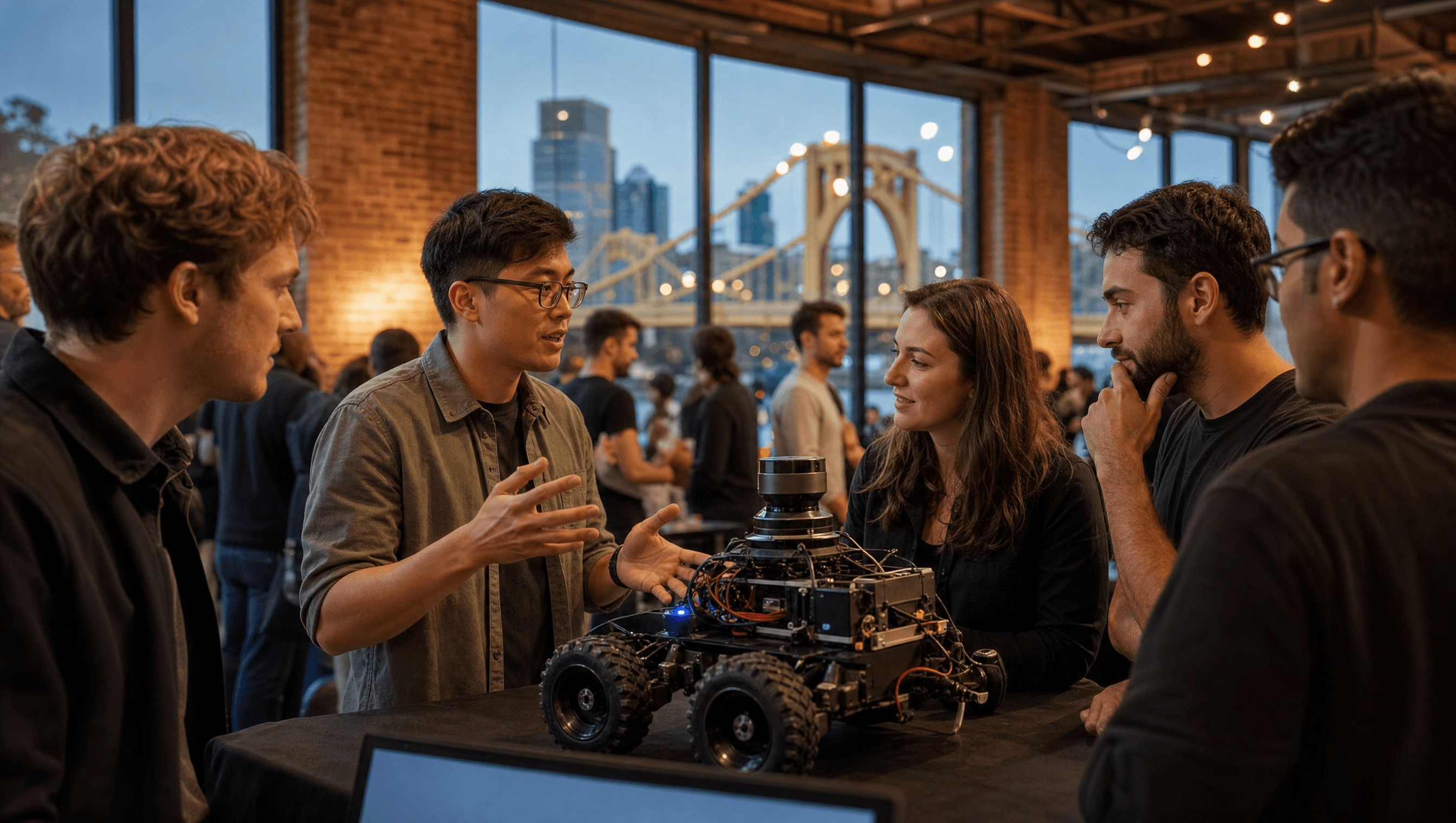
Robotics events in Pittsburgh are worth attending for one reason: this is arguably the densest robotics talent pool in the world. Between CMU’s Robotics Institute, its National Robotics Engineering Center, and the cluster of autonomy, space-robotics, and inspection-hardware companies they seeded, robotics events here draw people who build the actual systems — not just people who talk about them.
For founders outside robotics, these events are still undervalued. Robotics people are, by necessity, full-stack — perception, ML, embedded, manufacturing, and regulatory thinking in the same room. If you’re hiring hard-tech engineers, looking for technical co-founders, or selling into industrial customers, the robotics community is where those conversations start. If that’s your hunt, the hardware and IoT events guide and the co-founder search guide cover how to run those rooms deliberately.
AI-focused meetups have grown alongside the robotics scene, and the two communities overlap heavily — an autonomous-vehicle perception engineer and an ML-platform founder have more shared vocabulary than either does with a generic SaaS crowd. Treat Pittsburgh’s AI events as an extension of the robotics calendar, and check the AI/ML events roundup for the national picture.
How does the CMU startup community work?
The CMU startup community works as a conveyor belt: research becomes spinouts, spinouts become scale-ups, and scale-ups fund the next generation of founders. The Swartz Center for Entrepreneurship is the hub — it runs student venture programs like VentureBridge, hosts open-to-the-public programming, and connects the university’s technical talent to the regional investor and operator community. Project Olympus and related incubation efforts help early university ideas become actual companies.
For a non-CMU founder, the play is simple: treat the university as a public utility. Attend Swartz Center events. Hire CMU talent before a Bay Area company outbids you — Pittsburgh salary expectations remain well below coastal levels. And meet the professors who spin out companies; every Duolingo started as someone’s lab-adjacent idea. Founders still in school should read the student founder programs guide — the Pittsburgh version of that world is unusually well-funded.
The other half of the conveyor belt is alumni capital. CMU graduates who exited in bigger ecosystems increasingly angel-invest back home, and regional funds keep a deliberate presence at university events to catch spinouts early. Demo days are where that capital physically shows up, which is the next section’s problem.
Which demo days and pitch competitions happen in Pittsburgh?
Pittsburgh’s demo day calendar clusters around three sources: the AlphaLab accelerators run by Innovation Works, university showcases at CMU and Pitt, and periodic pitch competitions run by community organizations. For an early-stage founder, demo days are the highest-density rooms in the region — where else will one evening put every active seed investor in front of you?
Two ways to use them. As a spectator, a demo day is a market map: you see what’s getting built, what’s getting funded, and which investors ask which questions. As a founder, applying to an AlphaLab track is a forcing function — a deadline, a mentor network, and a room full of check-writers at the end. Either way, go in with a plan; the demo day and pitch competition guide covers how to prep, and the VC office hours explainer covers what those conversations actually mean.
After the event, the follow-up is the whole game. Pittsburgh’s investor community is small enough that a good conversation at a demo day reliably turns into a coffee within two weeks — if you send the note. Most people don’t. That alone is an edge; the non-salesy follow-up guide gives you the templates.
How much do Pittsburgh startup events cost?
Most Pittsburgh startup events are free or under $30. University showcases and coworking meetups are almost always free; accelerator demo days are free but may require registration; the occasional ticketed conference or dinner series runs $50–200. Compared with the $500–3,000 conference tickets in bigger ecosystems, Pittsburgh is effectively a free-to-play networking scene.
That changes the calculus of how many events to attend. In an expensive city, you must choose carefully; in Pittsburgh, the constraint is time, not money. The mistake to avoid is attending everything and converting nothing — five events a month with zero follow-ups loses to two events a month with five real follow-ups each. The event ROI framework is the honest way to audit yourself, and the free tech events guide explains where the free stuff hides.
How do you actually network at Pittsburgh startup events?
Networking at Pittsburgh startup events is easier than in bigger ecosystems because the rooms are smaller and the egos are calmer. The unwritten rule: lead with help, not with a pitch. Ask what someone is building, what’s broken this month, and who they’re trying to meet. In a community this size, being the person who makes introductions compounds faster than being the person who asks for things.
A few tactics that work especially well here. First, bring a specific ask — "I’m trying to reach the innovation team at a hospital system" gets remembered; "let’s connect" does not. The two-problem technique makes this automatic. Second, use the small ponds: the robotics crowd, the CMU crowd, and the investor crowd overlap enough that one strong impression travels. Third, if you’re attending solo, the conference buddy system works at meetups too — pair up with another founder and trade introductions all night.
And keep first-timer expectations calibrated: your first event is reconnaissance, not conversion. The first-time founder guide sets a realistic bar. Your job in month one is to become a familiar face. In Pittsburgh, familiar faces get pulled into rooms that never get posted publicly — that’s where the real ecosystem operates.
Explore more from 47Hz
Level up your event strategy with these guides — from working the room to measuring whether your calendar is actually driving results.
Networking guides
- How to Network at Tech Events
- How to Build a Founder Network from Scratch
- How to Follow Up After a Conference Without Being Salesy
- Networking for Introverts at Tech Events
Event strategy
- Startup Event ROI: How to Measure If It’s Worth It
- Demo Days and Pitch Competitions: A Founder’s Guide
- Tech Conferences vs. Intimate Networking Events
- Hardware and IoT Events for Startup Founders