MicroConf vs SaaStr: Which Conference is Better for Bootstrapped Founders?
MicroConf vs SaaStr — which conference is better for bootstrapped SaaS founders? Cost, value, networking, and content compared.
Choosing between MicroConf and SaaStr Annual is one of the most common dilemmas for SaaS founders planning their conference budget. Both events attract thousands of operators and investors, but they serve very different audiences. If you're a bootstrapped founder deciding where to spend your limited dollars, this comparison breaks down exactly what each conference offers — and which one fits your stage.
MicroConf is built for bootstrapped and self-funded SaaS founders. SaaStr Annual is built for venture-backed founders chasing hypergrowth. The networking, content, and vibe reflect those different missions. Below, we compare them across every dimension that matters: cost, content quality, networking value, speaker lineup, and who gets the most out of each event.
Find SaaS Conferences Near You
Browse upcoming startup and SaaS events in your city.
Browse live events →What is MicroConf?
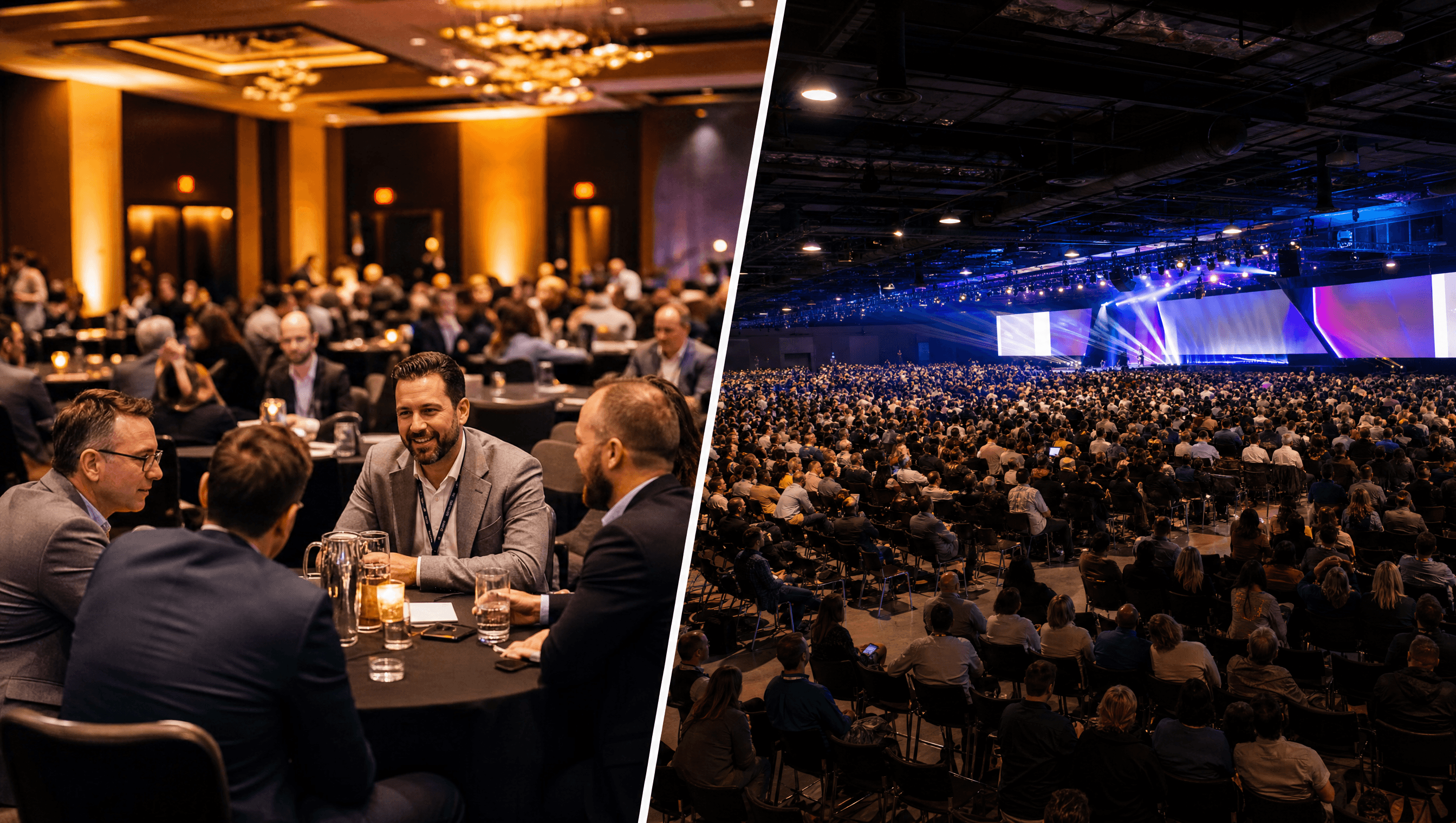
MicroConf is a family of conferences founded by Rob Walling, specifically designed for bootstrapped and self-funded SaaS founders. The flagship events include MicroConf US (typically held in cities like Minneapolis or Las Vegas) and MicroConf Europe. Unlike most tech conferences, MicroConf deliberately keeps attendance small — usually 500 to 800 attendees — to foster deeper, more meaningful connections.
The content focuses on practical, tactical advice: pricing strategies, churn reduction, content marketing for SaaS, hiring your first team, and growing from $1K to $100K MRR. Speakers are almost exclusively operators who have built and grown SaaS businesses, not investors or journalists. The average attendee runs a SaaS product between $10K and $2M in annual recurring revenue.
What is SaaStr Annual?
SaaStr Annual is the world's largest SaaS conference, founded by Jason Lemkin. Held in the San Francisco Bay Area, it regularly draws 10,000+ attendees including founders, VPs, and investors from companies at every stage — from pre-revenue startups to public companies like Salesforce and Datadog.
The content skews toward growth-stage and enterprise SaaS: scaling from $10M to $100M ARR, building sales teams, enterprise go-to-market strategy, and fundraising. Speakers include high-profile VCs, CROs, and CEOs of well-known SaaS companies. If you're bootstrapped and doing under $5M ARR, roughly 70% of the sessions won't be directly relevant to your current stage.
MicroConf vs SaaStr: Cost Comparison
For bootstrapped founders watching every dollar, the cost difference is significant.
- MicroConf ticket: Typically $500–$800 for a standard pass. Early-bird pricing can drop this to $400.
- SaaStr Annual ticket: Starts around $1,500–$2,500 for general admission. VIP and premium passes range from $3,000–$5,000.
- Travel: MicroConf rotates cities (often more affordable than SF). SaaStr is in the Bay Area, where hotels run $250–$400/night.
- Total budget: MicroConf: $1,000–$1,800 all-in. SaaStr: $3,000–$6,000 all-in.
MicroConf wins on cost by a wide margin. For a bootstrapped founder doing $200K ARR, spending $1,500 on a conference is reasonable. Spending $5,000 on SaaStr requires real justification.
Which Conference Has Better Networking for Bootstrapped Founders?
This is where MicroConf pulls decisively ahead. The smaller size means you can have real conversations with almost anyone. The attendee pool is heavily self-funded founders building profitable businesses — exactly the peer group you need. Many attendees describe making lifelong friends and mastermind partners at MicroConf.
SaaStr's networking is high-volume but shallow. With 10,000+ people, you'll meet more VPs of Sales from Series C companies than fellow bootstrappers. The "brain dates" and networking sessions help, but the signal-to-noise ratio for a bootstrapped founder is lower. If you're looking for investors or enterprise customers, SaaStr is better. If you're looking for peers who understand your journey, MicroConf is the clear winner.
Content Quality: Practical vs Inspirational
MicroConf talks are famously tactical. Speakers share exact numbers, specific tactics, and real case studies from their own businesses. You'll leave with a concrete action list — change your pricing page this way, reduce churn with this email sequence, hire your first support rep at this MRR threshold.
SaaStr content is more strategic and inspirational. Sessions like "How We Grew from $50M to $200M ARR" are fascinating but hard to apply if you're at $500K ARR. The content quality is excellent, but the relevance gap for early-stage bootstrapped founders is real. You'll hear about enterprise sales playbooks and board management — valuable someday, but not today.
Best MicroConf Content Tracks
- Foundations (pre-$10K MRR): Building your first product, landing pages, early marketing
- Growth ($10K–$100K MRR): Scaling marketing, hiring, pricing optimization
- Scale ($100K+ MRR): Team building, operations, product-led growth
Best SaaStr Content Tracks
- Enterprise GTM: Building outbound sales, managing large deals
- Product & Engineering: Scaling infrastructure, product-led growth at scale
- Leadership: Managing teams of 50+, board dynamics, culture
Speaker Lineup Comparison
MicroConf speakers are working operators. You'll hear from founders running $500K–$10M ARR SaaS businesses who are in the trenches. Rob Walling himself is a regular speaker and shares openly from his portfolio of SaaS companies. The community feel means speakers hang out in the hallway track, not in a green room.
SaaStr speakers are high-profile names: CEOs of public SaaS companies, well-known VCs from a16z and Bessemer, and VPs from companies like Slack, Zoom, and Notion. The star power is real, but access is limited — these speakers present on stage and leave. If you want face time with a founder running a $2M ARR business who built it the same way you are, MicroConf delivers that.
Which Conference Should You Choose?
The answer depends on your stage and goals. Here's a straightforward framework:
Choose MicroConf if you're bootstrapped, doing under $5M ARR, want tactical advice you can implement next week, and need a peer group of founders building the same way you are.
Choose SaaStr if you're venture-backed or planning to raise, doing over $5M ARR, want exposure to enterprise SaaS strategies, and are looking for investors or large-scale partnerships.
Choose MicroConf When:
- You're bootstrapped or self-funded
- Your ARR is under $5M
- You want actionable, tactical content
- You value deep, meaningful networking over volume
- You're looking for a community, not just a conference
Choose SaaStr When:
- You're venture-backed or planning to raise
- Your ARR exceeds $5M and you're scaling aggressively
- You need enterprise sales and GTM strategies
- You want to meet VCs and potential acquirers
- You're building a large team and need leadership frameworks
Can You Attend Both?
Yes, and many founders do — especially those in the $1M–$3M ARR range who are transitioning from bootstrapped growth to considering outside investment. MicroConf gives you the operational playbook and peer support. SaaStr gives you the growth-stage vision and investor network. Budget roughly $4,000–$7,000 for attending both in a single year.
If you can only pick one and you're bootstrapped, start with MicroConf. The ROI per dollar spent is significantly higher for self-funded founders. You can always add SaaStr once your revenue justifies the investment.
Other SaaS Conferences Worth Considering
MicroConf and SaaStr aren't your only options. Depending on your niche, these alternatives might be a better fit:
- SaaStock: Dublin-based SaaS conference with a strong European community. Similar vibe to MicroConf with a global twist.
- Business of Software: Cambridge, UK event focused on software business strategy. Deep, intellectual content.
- LTV Conf: Smaller, founder-focused event with curated attendees. Great for high-quality networking.
- Inbound: HubSpot's massive marketing conference. Better if content marketing and inbound are your primary channels.
How to Maximize Your Conference ROI
Whichever conference you choose, preparation is what separates a great experience from a wasted trip. Here's how bootstrapped founders get the most value:
- Set a specific goal before you go. "Meet three founders at my stage" is better than "network."
- Reach out to attendees in advance. Both conferences have Slack communities or attendee lists. Book coffee chats before the event.
- Take notes on tactics, not inspiration. Write down what you'll implement in the next two weeks, not vague "great ideas."
- Follow up within 48 hours. The connections you make lose value fast if you don't follow up while the conversation is fresh.
- Share what you learned. Write a blog post or tweet thread summarizing your takeaways. This reinforces your learning and builds your brand.
Explore more from 47Hz
Whether you choose MicroConf, SaaStr, or another SaaS conference, having the right preparation makes all the difference. Here's more from 47Hz to help you get the most from every event.
Events and networking
- How to Follow Up After a Tech Event
- The Definitive Startup Event Checklist
- Startup Weekend and Hackathon Guide
- Demo Day and Pitch Competition Guide
Guides for founders
- 2026 Startup Event Calendar
- Survey: What Events Drive Results for 500 Founders
- Tech Events for First-Time Founders