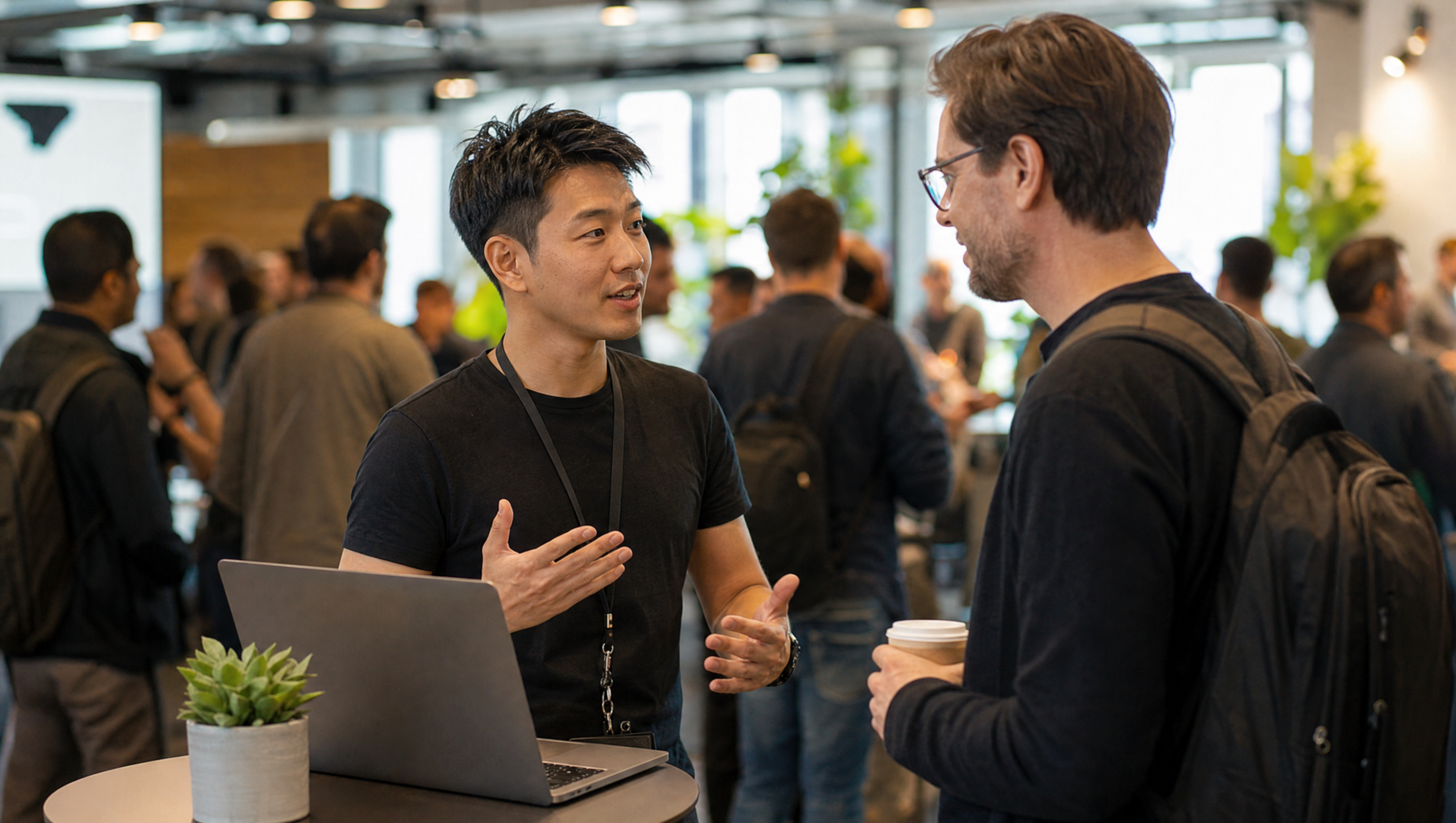
How to Get Your First 10 Customers at Startup Events
How early founders land their first 10 customers at startup events — picking rooms where buyers are, the conversation that leads to a pilot, and follow-up that closes.
Your first 10 customers will not come from a product page. They come from rooms — the meetup, demo day, and founder dinner where someone with a real problem happens to be standing three feet away from you. Yet most founders treat startup events as networking theater: collect cards, shake hands, follow up with a pitch blast, and wonder why nothing converts. This guide is the opposite of that. It is a field manual for using events as a customer acquisition channel, from choosing the right room to running the conversation that ends in a pilot.
The short answer: your first 10 customers come from events where your buyer actually shows up, conversations where you diagnose before you pitch, and follow-up that feels like a service instead of a sales sequence. Most founders can land 5–10 customers from events within 60–90 days if they work the pipeline deliberately.
Why startup events are the fastest path to your first 10 customers
Cold outreach gets you a 1–3% reply rate. Paid ads require budget and a conversion machine you probably do not have yet. But an in-person conversation with a warm prospect compresses weeks of trust-building into ten minutes. When someone meets you, watches you think about their problem in real time, and connects a face to the product, the sales cycle shrinks dramatically.
The pattern among founders who actually do this well is consistent: they pick events like an investor picks deals. They filter for buyer density, they go in with a diagnosis-first script, and they treat follow-up as a deliverable, not a reminder. If you want to go deeper on that mindset, our guide to choosing which startup events to attend breaks down how to evaluate a room before you spend an evening in it.
What kind of event actually produces customers?
Not all events are equal, and the distinction matters more than most founders realize. Generalist founder meetups are great for peer support and terrible for sales — everyone there is selling, nobody is buying. You want rooms where operators, growth leads, and decision-makers outnumber founders.
- Vertical industry meetups — healthtech, fintech, logistics nights where the practitioners in your target market gather. Highest buyer density per square foot.
- Customer conferences (not founder conferences) — the event your buyers pay to attend. You are the vendor crashing the party, politely.
- Demo days and showcase tables — structured permission to pitch. If you are technical and selling to technical buyers, our guide to sales events for technical founders covers which formats convert.
- Workshops and office hours — smaller rooms, longer conversations, built-in credibility for whoever is running the session.
A quick filter: before registering, ask "if I closed every plausible prospect in this room, what would that be worth?" If the answer is less than the ticket price and the evening, skip it. To find what is actually happening near you, browse the San Francisco, New York, Austin, Chicago, and Seattle event feeds — every city page is filterable by category and cost.
How do you prepare for an event to find customers?
Preparation is where customer-hunting founders separate from card-collectors. Three things before you walk in:
- Write your diagnosis question. One question you can ask any stranger that reveals whether they have the problem you solve. Not "what do you do?" but "how does your team handle X today?" If they light up or groan, you have a lead.
- Prepare a 20-second offer, not a pitch. "We help [specific buyer] do [specific thing] without [pain]." No adjectives, no buzzwords. It should sound like a sentence a human would say, because you will say it out loud.
- Set a quota. Three real diagnosis conversations per event. Not contacts collected — conversations where someone described their problem to you. Quality beats volume at this stage.
What conversation actually leads to a customer?
The conversation that converts is a diagnosis, not a demo. Your job in the first five minutes is to understand their problem better than they can articulate it, and the fastest way to get there is the two-problem technique: surface two competing pains and ask which one keeps them up at night. People reveal their real priorities when they are forced to rank.
When they describe a workflow, listen for the manual workaround — the spreadsheet, the intern, the Slack channel where requests go to die. That is your product's home. Then close the conversation with a bridge: "That sounds exactly like what we are building. Can I send you something small — a one-pager or a two-question survey — and we can figure out if it's a fit?" You are asking for permission to continue, not asking them to buy. If you struggle with openers, our list of networking conversation starters has field-tested ones that do not feel like a script.
How do you run customer discovery without creeping people out?
Customer discovery at events is a gift exchange: they give you context, you give them a solution to their problem — or at minimum, a genuinely useful referral. Be explicit about the frame: "I'm talking to 15 teams about this before we ship — no pitch, I just want to understand how you handle it." Disarming honesty outperforms stealth. When a conversation starts going deep, offer to book a proper call on the spot: "Can we grab 20 minutes this week? I'll send an invite tonight." The person who books the meeting on-site converts at multiples of the person who says "I'll email you."
How do you follow up so it actually closes?
The follow-up is where event leads go to die. A blast email with your deck attached reads as noise. The follow-up that closes references their specific problem in the first line: "You mentioned your team was manually reconciling vendor invoices — here's the one-pager on how we handle that, plus two questions about your current process." The non-salesy conference follow-up framework has templates you can lift verbatim, and if you met multiple people from the same company, our guide on following up after tech events covers sequencing so you do not trip over yourself.
Timebox it: every lead from last night's event gets a personalized message within 24 hours or it does not get sent. Ten good follow-ups beat fifty template ones.
What does the first-10-customers pipeline look like in numbers?
Run the math like a funnel, not a vibe. A realistic conversion chain from events:
- 20 diagnosis conversations per month (2–4 events)
- 12 of them warm enough to accept a follow-up
- 6 of those becoming calls or trials
- 2–3 converting to paying or committed-pilot customers per month
At that rate you cross 10 customers in roughly 60–90 days of consistent event attendance. The variance is enormous and mostly explained by room selection — a single well-chosen vertical meetup can outproduce a month of generic founder mixers.
What if you are pre-product or hate selling?
Pre-product, your currency is insight: you are selling the roadmap, so your ask is a design partner agreement, not a purchase order. And if selling feels unnatural, reframe it — you are not pitching, you are recruiting people into solving a problem you both care about. Founders who struggle with the transition from conversation to ask tend to do better with a pitch structure that fits the room, and with follow-up that references specifics from the conversation.
If you are running a booth instead of working a floor, the dynamics change — read the startup expo booth guide for the lead-capture setup that does not rely on a badge scanner.
The uncomfortable truth: your first 10 customers will tolerate a rough product, but they will not tolerate a founder who does not understand their problem. Events are the cheapest place to prove that you do.
Explore more from 47Hz
Networking
- How to Follow Up After a Conference Without Being Salesy
- How to Follow Up After a Tech Event
- How to Build a Founder Network from Scratch
Guides
- How to Choose Which Startup Events to Attend
- Sales Events for Technical Founders
- Tech Events for First-Time Founders
- The Startup Expo Booth Guide
Ready to put this into practice? Pick one room where your buyers gather this week and run the diagnosis-first playbook above.